

Original detourned comic strip is printed on p 180 of Vienet, “Enragés et Situationnistes dans le Mouvement des Occupations” (Gallimard, 1968)
Original detourned comic strip is printed on p 180 of Vienet, “Enragés et Situationnistes dans le Mouvement des Occupations” (Gallimard, 1968)
There will be a flood of these over the next week or so – so strap yourself in!
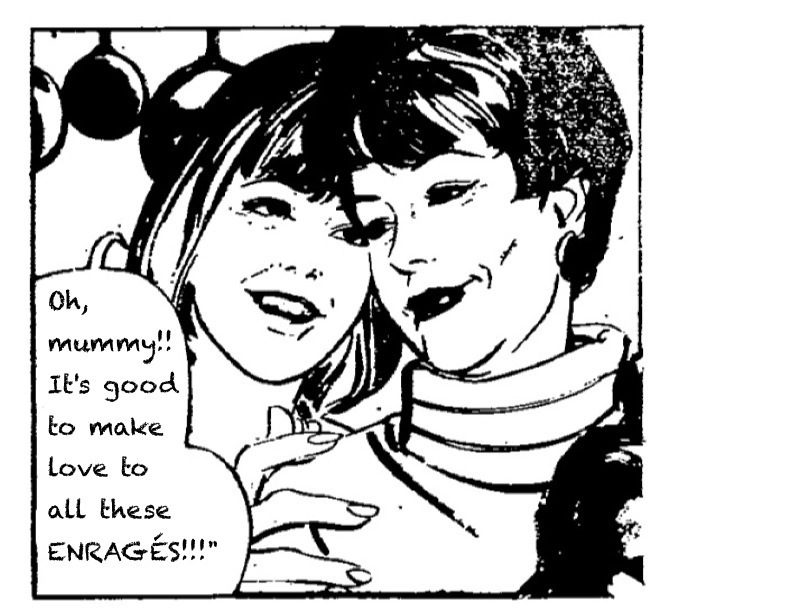
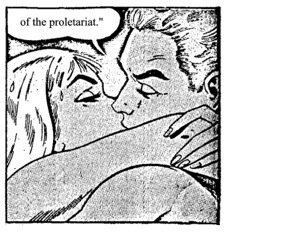
This is possibly the most self-referentially humorous of all the détourned comic strips that were so well used during the May 1968 uprising in Paris.

Original detourned comic strip is printed on p 178 of Vienet, “Enragés et Situationnistes dans le Mouvement des Occupations” (Gallimard, 1968)
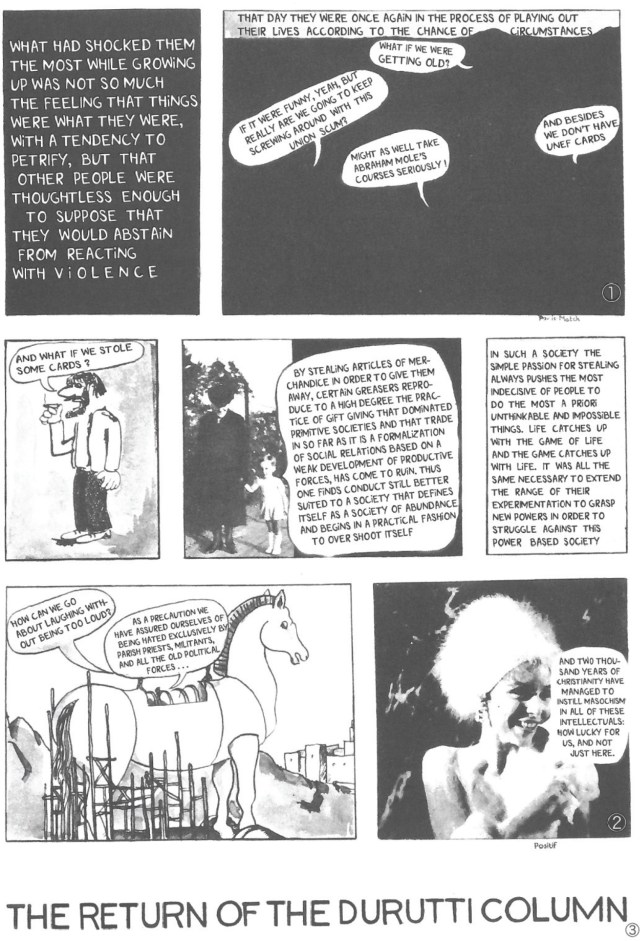
I was gearing up to begin to translate this famous document that was used by the Stasbourg AFGES to advertise the pamphlet ‘On the Poverty of Student Life’. Then I came across this on the intenet: The Return of the Durutti Column
For a direct link to a PDF of the whole document translated into English (including an introduction and footnotes), click on the image:
I have almost completed laying out the first chapter (of three) of Guy Debord & Ager Jorn’s ‘Memoires’. Which is actually only about a quarter of the work – as it is the shortest!
For a side-project from this side-project (which oddly involved actually resuming part of my main project!) I started to translate the text of the various comic strips detourned in the pages of internationale Situationniste. These will be used in the journal ‘facsimilies’ – and one has already been incorporated into the post of my translation of THE COMMON VIEW ON THE SI, THIS YEAR (IS #5).
Below is a selection of some of the others, which aren’t that meaningful out of context, but will give you an idea of the end results.



As you know, the main work of this blog is centred around producing “facsimile” English versions of the journal Internationale Situationniste. For the last few weeks a few other people and I have been discussing joining forces to take on the task as a collaboration – with potentially more significant outcomes (eg all-new translations, a print edition).
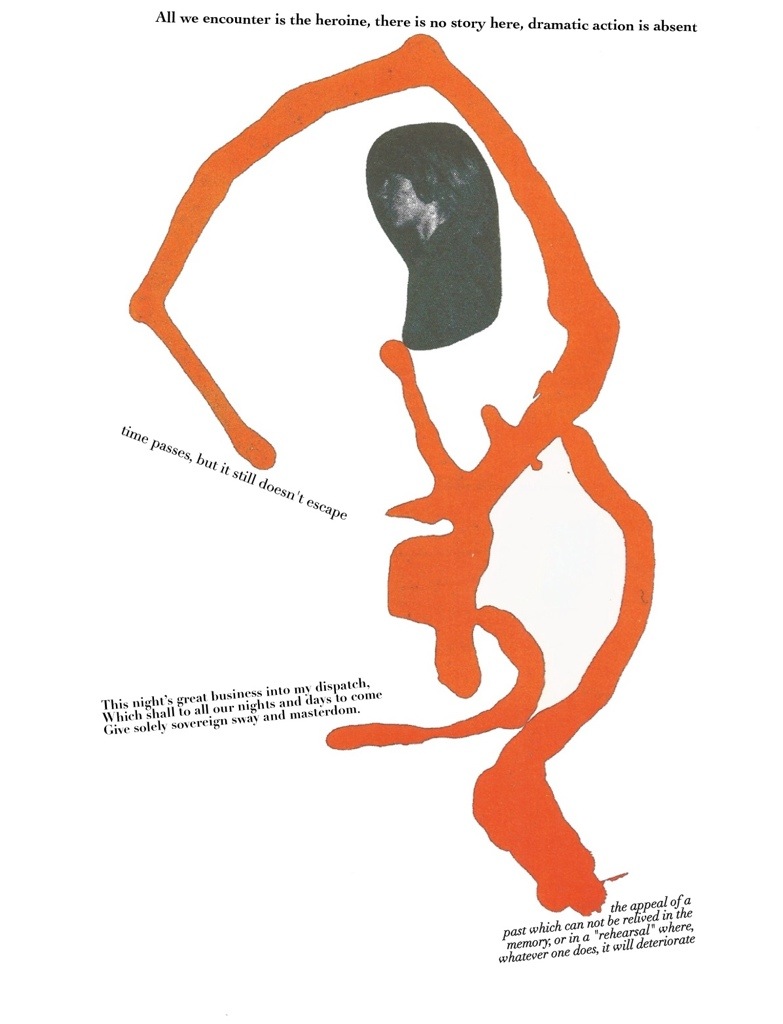
This will all take time to figure out – so in the meantime, I have decided to take on a side-project of producing a ‘facsimile” English version of Guy Debord & Asger Jorn’s ‘Memoires‘. Most of the translation work has been done – and I’m now working on integrating the text into the pages.
Obviously a pdf version will not allow for the sensation of handling the original’s sandpaper cover – but being able to read the text in English gives a good feel for the “narrative” of the original. Considering the entirety of the text is detourned from other sources – it has a surprisingly cohesive effect.
As examples of the work in progress I’m attaching the draft versions of the first 3 pages.


NOTICE
This translation is a first draft, and has not been independently proofread. However, to the best of my knowledge this text has never been translated into English. Therefore I am making it available in this form with the caveat that there are likely to be mistakes in it. PLEASE APPROACH IT WITH CAUTION!
Draft 0.2 (Revised 2 August 2013)
NOTE: Quote from Hegel’s “The Phenomenology of Mind” is from J. B. Baillie’s translation.
Captions and quotations from the ‘The Avant-Garde of Presence’ (IS #8)

The Situationists between two meetings at the Antwerp Conference
“”Marxism being an error, one has seen at what level they place themselves, [these plagiarists? – fr. plagieurs] of the twentieth order, [when] from an ideology (which they make shakier still), they extract a conception of cultural ruination which is completely lunatic – even to sub-Marxists.
“The Situationists critics want to lay their hands on all means of communication, without having created any, at any level, and to replace them with various creations and trivialities – the results of their unique and enormous triviality. In extreme demonstrations of their present impotence these cretins, we say, represent excretions of a Hitlerian or Stalinist type, the best-known and outrageous examples of which are the nazi gangs of America and England.”
(Les Cahiers du Lettrisme, n° 1, December 1962)
[this image and caption printed in IS #8, p. 15]
RENDEZ VOUS, BUT WHERE?
While at Saint-Lazare Station you still have to wait for others, search for them, or just wander through the halls of The Unlost – Orly Airport is going to offer a well-defined “rendezvous point” which will remove all the uncertainty. This is a huge metal sphere, suspended in the middle of the hall on the ground-floor, surrounded by a illuminated sign unambiguously reading “meeting place”.
(Elle, 31-8-62)
[this quotation printed in IS #8, p. 16]

Marilyn Monroe, August 5, 1962: in the society of the spectacle the specialization of mass entertainment is the epicenter of separation and non-communication.
“Consciousness… immediately transcends what is limited, and, since this latter belongs to it, consciousness transcends its own self. Along with the particular there is at the same time set up the “beyond”, were this only, as in spatial intuition, beside what is limited. Consciousness, therefore, suffers this violence at its own hands; it destroys its own limited satisfaction. When feeling of violence, anxiety for the truth may well withdraw, and struggle to preserve for itself that which is in danger of being lost. But it can find no rest. Should that anxious fearfulness wish to remain always in unthinking indolence…”
Hegel. The Phenomenology of Mind.
[this image and caption printed in IS #8, p. 19]
“Critique of Separation”
“Don’t be idiotic, she said, you want to save the world, but there’s nothing you can do. This conspiracy is not on an earthly scale, nor even on that of the solar system. We are the pawns in a game played by the people of the stars. ”
(A.E. Van Vogt. The World of Null-A)
[this image and caption were printed in IS #8, p. 20]
From Internationale Situationniste no. 8, January 1963 (p 15, 16, 19, 20). Translated by Ian Thompson (July 2013)
The article these captions are containing within is available here, in English translated by John Shepley.
Full pdf of Internationale Situationniste no. 8 (in original French) can be downloaded from UbuWeb.
NOTICE
This translation is a first draft, and has not been independently proofread. However, to the best of my knowledge this text has never been translated into English. Therefore I am making it available in this form with the caveat that there are likely to be mistakes in it. PLEASE APPROACH IT WITH CAUTION!
Draft 0.0
WELL SAID SI!
“The Council has decided that all people who collaborate with the journal Arguments starting from January 1st, 1961, cannot be admitted under any circumstances, now or in the future, among the Situationists. The announcement of this boycott draws its force from the importance that we know the S.I. secures at least in the culture of the years ahead. Interested parties can bet, on the contrary, on the dubious company it will attract.”
(Resolution of the C.C. Of the SI, 6 November 1960, published in Internationale Situationniste 5 – page 13 – December 1960.)
“Maybe one day we’ll dare to face the problem of God, to question religion and the sacred.”
(Opening statement of the editorial of Arguments number 24, fourth quarter 1961, published in March 1962.)
“One could go so far as to term this level of everyday life a colonised sector… Everyday life, policed and mystified by every means, is a sort of reservation for the good natives who keep modern society running without understanding it — this society with its rapid growth of technological powers and the forced expansion of its market.
(Internationale Situationniste 6 – page 22 – August 1961.)
“Today it strikes [one] that everyday life, considered in sum, can be seen as the colonised domain of existence, as a “reservation” for the good natives who keep society running, [and which has] become the enemy of any militant activity. ”
(Arguments number 25-26 – page 46 – 1st and 2nd quarters of 1961, published in June.)
“All texts published in Internationale Situationniste may be freely reproduced, translated and adapted, even without indication of origin.”
(Anti-copyright warning at the beginning of all issues of I.S.)
AND NOW, THE PROOF OF OUR JUDGMENT IS MADE:
“ARGUMENTS” HAS TO DIE!
From Internationale Situationniste no. 8, January 1963 (p 18). Translated by Ian Thompson (July 2013), except for
quote from ‘Internationale Situationniste 5 translated by Anthony Hayes “with help from NOT BORED!”,
and quote from ‘Internationale Situationniste 6 translated by Ken Knabb
Full pdf of Internationale Situationniste no. 8 (in original French) can be downloaded from UbuWeb.
Text in original French
L’IS. VOUS L’AVAIT BIEN DIT !
« Le Conseil a décidé que toute personne qui collaborera à la revue Arguments à partir du 1er janvier 1961 ne pourra en aucun cas être admise, à quelque moment de l’avenir que ce soit, parmi les situationnistes. L’annonce de ce boycott tire sa force de l’importance que nous savons garantie a l’I.S. au moins dans la culture des années qui vont suivre. Aux intéressés de risquer le pari contraire, si les conipagnies douteuses les attirent. »
(Résolution du C.C. De l’I.S., le 6 novembre 1960, publiée dans Internationale Situationniste 5 – page 13 – décembre 1960.)
«Peut-être oserons-nous un jour affronter Dieu-probleme, questionner le sacré et la religion. »
(Déclaration liminaire de la rédaction d’Arguments, numéro 24, du quatrième trimestre 1961, paru en mars 1962.)
«On peut aller jusqu’à qualifier ce niveau de la vie quotidienne de secteur colonisé… La vie quotidienne, mystifiée par tous les moyens et controlée policièrement, est une sorte de réserve pour les bons sauvages qui font marcher, sans la comprendre, la société moderne, avec le rapide accroissement de ses pouvoirs techniques et l’expansion forcée de son marché.»
(Internationale Situationniste 6 — page 22 — aout 1961.)
«Ce fait aujourd’hui éclatant que cette vie quotidienne, considérée en somme, comme le domaine colonisé de l’existence, comme la «réserve» pour les bons sauvages qui font marcher la société, soit devenue l’ennemie même de toute activité militante. »
(Arguments numéro 25-26 – page 46 – des 1er et 2er trimestres de 1961, paru en juin.)
« Tons les textes publiés dans Internationale Situationniste peuvent être librement reproduits, traduits ou adaptés même sans indication d’origine. »
(Avertissement d’anti-copyright au début de tous les numéros d’I.S.)
DESORMAIS, LES PREUVES DE NOTRE JUGEMENT SONT FAITES :
« ARGUMENTS » N’A PLUS QU’A DISPARAITRE !
NOTICE
This translation is a first draft, and has not been independently proofread. However, to the best of my knowledge this text has never been translated into English. Therefore I am making it available in this form with the caveat that there are likely to be mistakes in it. PLEASE APPROACH IT WITH CAUTION!
Draft 0.2 (revised 5 August 2013)
Translated comic included.
THE COMMON VIEW ON THE SI, THIS YEAR
(press review)
GERMANY
“The members of the Munich group (“Spur”) follow the current of the Situationist International (leader: A. Jorn) … While Courageous in words, their progress is slowed, handicapped by their cumbersome mentality. Desires; ability : what a contrast! ”
Vernissage, October 1960.
“But what do these young Samsons intend to take the place of the corrupt order they wish to tear down? Here they look to the Situationists, a movement to which they belong. They cite the manifesto of May 17, 1960 … This is evidently some form of international group, which held a Congress (naturally an international one) in 1959. So, what is it?
“Artists,” the manifesto says, “have been completely separated from society, just as they are separated from each other by competition.” Well said! And here, our Situationists have discovered the origin of the greatest ills. In it’s place, Guy Debord and his friends imagine the creation of a “situationist culture,” which would require a “general participation” of everyone. In place of preserved objects, art would be “in community with the directly lived moment” – a universal and anonymous creation. This would imply, we suspect, “a revolution of behaviour” … There are actually many signs of growing dissatisfaction, a “crisis of culture”.
But the goals of these rebels are not so different from those of others. Before declaring the monochrome to be an unproductive polemic – are they not themselves polemicists? – the partisans of “Spur” should study the theatre of Gelsenkirchen, and the manifestos of Yves Klein. The “gouvernement de la sensibilité” is not as far away as they think from their own “situationist culture.” Only it was devised with much more precision. ”
John Anthony Thwaites, “Furious Pioneers”
(Deutsche Zeitung, 23-9-60).
“To break the impasse, this young group sees only one alternative: to renounce painting as an individualist art in favour of it’s use in a new “situationist” setting. What a monstrous word! Such manifestos are interesting as symptoms of anxiety and discomfort, they can also contain elements of the truth, but the authors are so attached to their ideas and slogans that the truth escapes them. ”
Fritz Nemitz
(Die Kultur, October 1960).
FRANCE
“In addition to the achievements of their “critical” aesthetic, the protagonists of this movement have considered in their theory a third horizon, in which painting seeks to transcend itself – where it acknowledges that it is outdated and and should be replaced by a universal, more concrete art. Doesn’t the development of technology, in effect, create new structural possibilities, not simply imaged, but practically realisable in the form of new situations? Their direct relationship with action shows that the old, seemingly lost, sense of immediacy is still there in spirit.”
François Choay.
(Arguments, No. 19, October 1960).
“Cultural research (into material and artistic forms, philosophical mechanisms and scientific truths about man and nature) involves a long and patient effort, and any break with this concept can only signal a return to barbarism …
“However, some intellectuals who are unable to integrate their vague and distorted vision – contradicted by experience – into culture, prefer to reject the culture itself rather than review their concepts or review themselves … The Situationists, who claim (in the name of working towards the society of the future) to break with the elements of culture, go so far as to reject them in order to substitute brutally “vitalist” values. Values which are sub-cultural, not even Marxist, but worse, troglodyte.
“I say worse, because here we go beyond the basest Marxism to approach outright fascism – the reaction (repeated under various pretexts) that we have known ever since Caliph Omar and the total destruction of the Library of Alexandria, right up to cultural destuction of Goering. Intending to increase its power in society, the Situationist International, like other “neo” proletarian or nationalist groups can try at times to stifle (from the outside) the natural growth of the culture, but in the end the research of those who respect knowledge will reject and punish these ignorant reactionaries, as it has rejected and punished others in the past.
“And when I consider how many offences there have been over the years as striking as Nazism, Communism or, on a smaller scale, the expression of the Situationists – which have unnecessarily destroyed so much energy – I understand why some want me to commit myself to applying some of my resources to reveal these deceptions. ”
Poésie Nouvelle, Special Issue on the SI (N° 13, October 1960).
Found in Paris, 13, rue de Mulhouse.
“Megalomaniac egotism, in the relationships between artists. leads to a thirst to overtake all others while taking care not to push yourself too hard.
As I have written and said.”
Robert Estivals, “Letter to Debord on the consequences
of megalomania …” (Grammes, No. 5).

CANADA
“Well, No! I refuse to assume that there is deep thinking behind hollow words and the use of expressions without knowledge of their exact meaning … It is really necessary [to stand up when someone] kills the French language as blithely and with such assurance.
It will nevertheless one day end, with these pseudo-intellectuals of a false avant-garde who are still to show ”their wee-wee”. When one embarks on a Critique for a Construction of Situation, one is in danger of going too far, especially with a helmsman like Patrick Straram who publishes texts rejected elsewhere without asking if his little writings were rejected not because of their courage, but simply because they are insignificant and pitiful.”
Jean-Guy Pilon (Liberté 60, n° 9-10, été 1960).
“I stumble over a vocabulary at the same time scatty and already sclerotic, which still fails in any renewal of the commonplace. I note, once again, this more or less conscious desire for the intellectual safety of another scholastic system – which has the same freshness and spontaneity of terminology and context as medieval thought. ”
Clément Lockquell (Le Devoir de Montréal, 16-7-60).
“I cannot say how disappointed I was. The tone of it, the words used, call for an entire scenario to be reinvented. And this Situationist International, which calls itself an “International”… Life is too cruel for us to take it seriously. Surrealism was true, Situationism remains a construction of some cultivated minds … But we must speak clearly. Henault, Miron, Portugais, Lapointe, Dubé speak clearly. But they don’t seem to be Situationists and are in appendices to Patrick Straram’s book. We learn to separate our own personal and sexual problems from those of other people. To prefer the people … say it all, but speak clearly. Only then will we invent the scenario in which others are able to live. Our children for example.”
Jacques Godbout (Liberté 60, n° 9-10).
From Internationale Situationniste no. 5, December 1960 (pp. 15-18). Translated by Ian Thompson (July 2013).
Text in original French here.
Full pdf of Internationale Situationniste no. 5 (in original French) can be downloaded from UbuWeb.
NOTICE
To the best of my knowledge this text has not previously been translated into English.
Draft 1.0
THE SITUATIONISTS IN AMERICA
While in London in October, Jorn requested a visa from the U.S. embassy so that he could travel through New York on his way to Mexico. In the past, he had received several invitations from American cultural organisations. However when Jorn was required to swear that he had never been a member of the Communist Party or any related organisation, and that he had never been jailed for any crime, he obviously refused with indignation. With his entry to the United States forbidden, Jorn wrote to the Carnegie Foundation in Pittsburgh, forbidding any official showcase of his artistic work in America – as its creator is considered “undesirable” in that country.
Before leaving France, Jorn had (in his letter of 20 September to the Danish newspaper Politiken) exposed another form of hypocrisy which, posing as mindless praise, aims at the falsification of the recent history of the experimental avant-garde, and his own role in it:
“On September 10, Politiken published an article entitled ‘The Great Asger’. Let me correct certain mistakes. My encounter with Dotremont at the Silkeborg sanatorium in 1951 did not mark the beginning of Cobra (the Internationale of Experimental Artists), nor of our personal friendship. On the contrary, this period actually constitutes an end on two levels: first, the financial failure of of the Cobra experiment had driven each of us to physical exhaustion; further, the deep ideological differences that arose between Cobra’s various members had already led to the definitive end of their collaboration …
“The Cobra movement (which was strongly supported by artistic authorities in Holland and Belgium, but had never received recognition in Denmark) chose to dissolve itself in 1951 (see the notice in issue 10 of the journal Cobra).
Between 1953 and 1957, I was involved with the Imaginist Bauhaus, primarily in Italy, France and Great Britain. As the movement’s experimentalist posture opposed any practical teaching of the arts, I could not have run the school of ceramics that you refer to.
“My recent book, “Pour la Forme” summarizes the theoretical work I undertook during this time, having moved beyond Cobra’s orientation. This period itself has ended … I am now involved with the research activities of the Situationist International, and I like to hope that such activities will be understood in my own country more quickly and more accurately than the earlier phases of my involvement with modern art. ”
Politiken’s editor replied a few days later with embarrassment, claiming to apologize by suggesting that the incriminating article, written by Dotremont, had suffered from cuts. This response had the audacity to suggest that Dotremont might have honestly believed to be a greater friend of ours than he in fact was, and, giving his current address, scandalously suggested making direct contact with him to clear up the misunderstanding. Meanwhile Politiken deemed it less than appropriate to publish the corrections, which amounted to less than a tenth of the confusionist article. The SI, in a letter signed by Khatib, clearly broke from the dishonest attempt at dialogue:
“Mr. Editor, the part played by the systematic false-witness of Christian Dotremont is in no way diminished because the editor of Politiken carried out various cuts in the assistance of his counter-truths.
“We maintain no ties with Dotremont, who knows perfectly the contempt in which we hold him.
On the other hand, if Politiken, which took it upon itself to release such a text, now refuses to publish the corrections it requires, we will publish these elsewhere – including, obviously, in the next issue of our journal – making note of how right of reply is treated in your newspaper.”
From Internationale Situationniste no. 2, December 1958 (pp. 3-310). Translated by Ian Thompson (July 2013). Proofed and corrected Oct 2014.
Full pdf of Internationale Situationniste no. 2 (in original French) can be downloaded from UbuWeb.
NOTICE
This translation is a first draft, and has not been independently proofread. However, to the best of my knowledge this text has never been translated into English. Therefore I am making it available in this form with the caveat that there are likely to be mistakes in it. PLEASE APPROACH IT WITH CAUTION!
Draft 0.0
NEWS OF THE INTERNATIONALE
Activity of the Italian Section
An exhibition showing the the first rolls of industrial painting produced by Pinot Gallizio, (with the assistance of Giors Melanotte in our Experimental Laboratory in Alba) opened at a Turin gallery on May 30 last year. This exhibition, which almost immediately moved to Milan (July 8), marks in our eyes a decisive turning point in the movement to overcome the old forms of art, and at the same time signals the beginning of their transformation with new vigour. As the slogan of our Italian comrades goes: “Against art-for-art’s-sake, against applied art – the application of art in the construction of ambiances”
In a text published in Turin and subsequently reissued in Milan, Michèle Bernstein presents the theoretical justification for this experiment:
“It is difficult to grasp every one of the benefits of this amazing invention at the same time. In no particular order: no more problems with size – the canvas is cut before the eyes of the satisfied buyer; no more poor periods – the outcomes of industrial painting, due to the mix of chance and mechanical processes, are never ‘uninspired’; no more metaphysical themes – industrial painting does not support them; no more doubtful reproductions of eternal masterpieces; no more gallery openings. And of course, soon, no more painters, even in Italy …
“The progressive domination of nature is the history of the overcoming of certain problems, moved from ‘artistic’ practice – casual, unique – into mass distribution in the public domain, ultimately resulting in the loss of all economic value.
“Faced with such a process, the reaction is always to give currency to old problems: the real Henry II buffet vs. the fake Henry II buffet, the forged canvas that is not signed, the excess numbers of a limited edition of something or other by Salvador Dali, the primacy of the hand-made. Revolutionary creation attempts to define and disseminate new problems and new constructs, and they alone have any value.
“When faced with the profitable tom-foolery which has continuously propagated itself over the last twenty years – the industrialisation of painting appears to be a technical innovation which must be implemented without any further delay. The greatness of Gallizio is that he has boldly pursued his tireless research, and has reached the point where nothing is left of the old pictorial world. No-one can be unaware that the previous steps in trying to overcome and destroy the pictorial object – whether abstraction pushed to its limits (the way opened by Malevich), or painting deliberately subjected to extra-artistic concerns (eg the work of Magritte) – haven’t been able, after all these decades, to leave the current repetitive state of artistic negation, all within the framework imposed by pictorial means themselves: a negation of “the interior”.
“Posing the problem in this way, however, will always result in endless repetitive activity, which cannot provide any of the elements of a solution. Meanwhile, all around us, the world keeps on changing before our eyes.
“At the stage we have now reached, that of experimenting with new collective constructions and new syntheses, there is no time to fight the values of the old world with a neo-Dadaist refusal. It necessitates the unleashing of inflation everywhere – as these values are ideological, artistic, even financial. Gallizio is at the forefront. ”
In his contribution, Asger Jorn declared at the end of the exhibition:
“It would be wrong to imagine that the industrial painting of Pinot Gallizio can be placed amongst the efforts of Industrial Design. There is no model to reproduce, instead it is the realisation of a unique creation, perfectly useless except in Situationist experiments with ambiances – it is painting to buy ‘by the yard’.
“Social success is measured by the appreciation of effort. It is obvious that this type of assessment is in direct conflict with Gallizio’s intention of devaluing painting.”
Commenting on the unexpected commercial success of industrial painting (“No one came to buy a piece of painting at an economical price, rather the production was sold in entire rolls to collectors who are amongst the most intelligent in Europe and America…”), Jorn emphasised that we should take into account this unexpected, additional economic experience. It is, in fact, the first defensive reaction of the art market which, hesitating to declare that this painting was not part of the real art world, has preferred at this point to simply integrate it into its own values, treating each roll as if it was a single huge painting, subject to the usual criteria of taste and talent.
The Situationists responsible for “Operation Industrial Painting” are now trying to counter this risk by two measures: increasing the price (quickly raised from 10,000 to 40,000 lire-per-meter at the end of August), and the production of longer individual rolls (until June the longest did not reach 70 meters). The use we can make of industrial painting depends, in the immediate present, on the opportunity for implementing a radical break with the presentation of art in galleries, and also in the development of work processes – which must get beyond the artisanal stage, to reach truly industrial efficiency.
On this technical question Giors Melanotte and Glauco Wuerich have completed a well-documented study which emphasises the following:
“It is especially important to answer the questions that arise around the term ‘industrial’. With this word we do not want to link artistic production to the criteria of industrial production (working time, cost of manufacture), or to the intrinsic qualities of the machine, rather we are establishing a quantitative idea of production.
“Lack of space was one of the biggest difficulties we encountered during the execution of the first examples of industrial painting. In a suitable installation for this type of production, it is necessary to have ample premises, very large in the sense of a lot of air and light. For us, without an adequate space, it was necessary to use gas masks to avoid the harmful effects of the solvents’ fumes…
The main difficulty to get over in order to achieve a sufficient quantity of production is actually to get hold of paint that is fast drying.. This is what will give character to industrial painting, it will work well with it. ”
Just as they presented industrial painting to an astounded public and the stupid commentary of the newspapers (who were especially struck by the presence of two cover-girls dressed in industrial-paintings at the opening in Turin), the Italian Situationists found themselves driven to act on another front.

At the end of June, a young Milanese painter, Nunzio Van Guglielmi (who is otherwise completely insignificant), slightly damaged a painting by Raphael (“The Coronation of the Virgin”) in an attempt to attract attention to himself. On the protective glass of the painting he placed a sticker with a handwritten sign reading: “Long live the Italian Revolution! Down with the Clerical Government!” Arrested on the spot, he was immediately (without any possibility of contestation and for that act alone) declared insane and interned in an asylum in Milan.
The Italian section of the Situationist International issued a protest in the tract “Difendete la Libertà Ovunque”, published July 4 by themselves, having had several Italian printers prudently refuse to publish it.
“We certify”, said the leaflet, “that the content of the placard affixed to Raphael’s painting by Guglielmi… expresses the opinion of a large number of Italians, ourselves included.
“We would like to draw attention to the fact that it would be a crime against veritable psychiatric science to interpret this act of hostility towards the Church and the dead cultural values of the museum, with the help of the psychiatric police, as a sufficient proof of madness.
“We emphasise the peril that such a precedent poses to all free men and all cultural and artistic development to come.
“Freedom lies in the destruction of idols.
“Our appeal is addressed to all the artists and intellectuals of Italy, for whom the liberation of Nunzio Van Guglielmi from life-long internment is an immediate question. Guglielmi can only be condemned in terms of the law that foresees the alienation of public goods.”
In a second tract, “Help Van Guglielmi!”, published in French on July 7, Asger Jorn, on behalf of the SI, supported the action undertaken:
“The rationale of Guglielmi lies at the heart of modern art, from Futurism to the present day. No judge, no psychiatrist, no museum director is able to prove otherwise without falsification …”
“The photo of the Raphael which was sent to the world’s press is an official falsification. So little real damage was done to the canvas that it could not possibly be seen when reproduced in a newspaper. The lines which can be seen in the photo, which seem to indicate a massive destruction of the canvas, are actually only the broken glass in front of the picture. In the photo these lines have even been artificially enhanced with black and white to make the incident seem more serious. And somehow the text of the manifesto pasted on the glass has become, through a strange process, totally illegible in the Italian newspapers.”
That very same day was the Milan exhibition’s opening. Our Italian section, reinforced by other situationists who were in Italy (Maurice Wyckaert, of the Belgian section, Jorn), distributed the leaflets in Milan amidst general hostility. A magazine went as far as to publish a reproduction of the Raphael to be compared to a reproduction of a painting by the fools who wanted to destroy it. However on July 19, to the amazement of all, Guglielmi was declared perfectly sane by the director of the asylum in Milan, and released.
The conclusion of this incident is very instructive: Guglielmi (who was fearful) agreed, in order to obtain his pardon, to be photographed kneeling and praying before the Virgin by Raphael – at the same time worshiping both the art and the religion he had previously abused. And the wholly justified position of the Italian section in this affair, from beginning to end perfectly rational, nevertheless helped increase its isolation from the intellectual rabble of Italy – whose nauseating elements (such as the merchant Pistoi, director of the magazine Notizie), after having the fraudulence to turn against the Situationists, had clearly revealed where they had their true camp: with Michel Tapie, that export of French neo-fascism that the priests cannot forget.
From Internationale Situationniste no. 2, December 1958 (pp. 27-30). Translated by Ian Thompson (July 2013), except for quote from ‘Difendete la Libertà Ovunque’ translated by NOT BORED!
Text in original French here
Full pdf of Internationale Situationniste no. 2 (in original French) can be downloaded from UbuWeb.



 Internationale Situationniste in English